
Barriers
Only 6,500 companies — less than 1% of all U.S. companies — offer ESOPs
The model works. Years of academic research proves it. Yet ESOP adoption is stagnant. Here are the five reasons why.
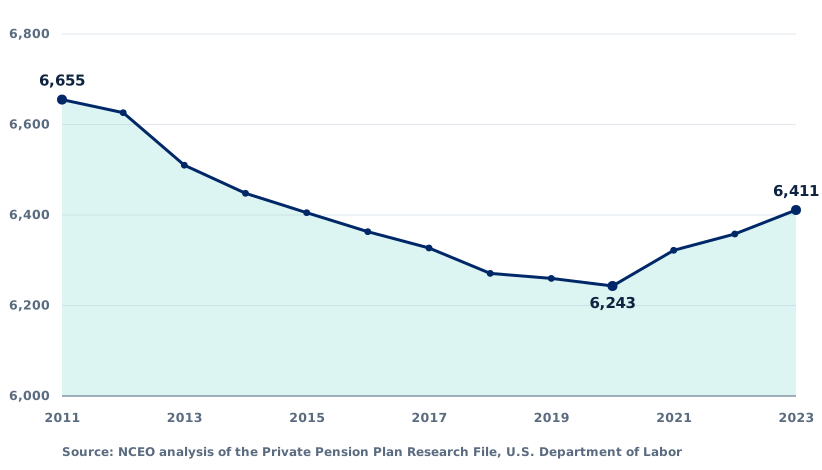
New ESOP formations have tended to run under 300 a year, concentrated in a few industries and smaller companies. The overall count of ESOPs has been flat, and slightly down, since 2015 — meaning more companies are leaving ESOP ownership each year than are adopting it.
Most ESOP activity takes one of two forms: 100% ESOPs, used mostly by smaller businesses with simpler ownership; and partial ESOPs, which can be more readily implemented in a much wider variety of situations, with the potential to reach many more workers. Partial ESOPs are in decline.
Companies with ESOPs
01
Statutory and regulatory complexity
The complexity, and the litigation risk that comes with it, is something many companies are simply not willing to tolerate. Unclear rules have dissuaded employers from offering these plans — the opposite of what Congress intended when it created ESOPs in 1974.
02
Prohibitively expensive, because the corporate tax incentives are limited
For a partial ESOP (typically structured as a C-Corp) the key corporate benefit is a deduction for ESOP contributions. At the federal corporate income tax rate of 21%, a company sees $21 of tax savings for every $100 it gives employees. For many companies, especially those with diverse or institutional shareholders, this inherent dilution makes ESOPs difficult to adopt.
03
Tax benefits to sellers are largely limited to small business owners
There are tax benefits for shareholders who sell at least 30% of the company to an ESOP, but they are only relevant to small businesses with a handful of individual owners — missing a large swath of the economy.
04
Long transaction timelines
The timeline for establishing an ESOP is often incompatible with the timeline on which companies are bought and sold. Many businesses are sold through competitive auctions on tight schedules — and because an ESOP takes several months to put in place, it simply is not competitive in those situations.
05
Limited liquidity available to sellers
How much cash a seller can take at closing is limited by the company’s debt capacity, because employees bring no capital to the table and debt financing is the main source of cash. A single founder-owner may accept less at close to get a deal done. Convincing several shareholders in a scaled business to do the same is considerably harder.
How can we reverse this trend?
We need to find a compelling way to reinvigorate partial ESOP activity.
That would make ESOPs relevant to far more of the economy — software, media, retail, financial institutions, consumer products, pharmaceuticals and medical devices among them. Several issues have to be addressed to get there, including litigation risk and the need to balance the tax benefit against the cost of sharing ownership with workers.